

In the fast-paced digital landscape of the United States, new software emerges constantly, promising to simplify workflows and boost productivity. The new software name 8tshare6a USA has gained attention as an AI-powered file management and media conversion tool, capable of running across Windows, macOS, and Linux systems. It offers features like cross-device sync, version history, and even AI-driven file scanning.
But beneath its polished interface lies a more concerning reality: a software identity crisis that can wreak havoc not only on your system’s security but also on your mental and physical well-being. Studies on digital burnout show that over 60% of US adults report mental fatigue from constant digital tasks, and software that behaves unpredictably or introduces malware can be a significant trigger.
This guide will explain exactly what 8tshare6a is, why it might be linked to fatigue and anxiety, and how you can protect your health without falling into the trap of digital exhaustion.
Table of Contents
Quick Summary: What the New Software Name 8tshare6a USA Really Is
| Aspect | Details |
| Official description | AI-powered file management, media conversion, and cloud sync tool for Windows, macOS, and Ubuntu |
| Key features claimed | End-to-end encryption, AI file scanning, cross-device sync, version history, “Quick Drop” codes |
| Pricing model | Free tier (5 GB storage); premium plans start at $4.99/month |
| Major concern | No official developer or website; often distributed via cracked/pirated software bundles |
| Potential risks | Malware, spyware, system crashes, data theft, legal consequences |
| Safety verdict | Avoid downloading from third-party sites. If you already have it, scan your system immediately. |
Bottom line: While some sources describe 8tshare6a as a legitimate file-sharing utility, independent investigations warn that the new software name 8tshare6a USA is frequently a filename used for pirated software bundles, containing cracked versions of Adobe Creative Suite, Microsoft Office, and other high-value applications. This dual identity makes it a high‑risk download for any US adult.
What Most People Misunderstand About 8tshare6a and Digital Fatigue
“It’s just another software tool – what harm could it do?”
This is the most common and dangerous misconception. Software like 8tshare6a isn’t just a neutral utility; it can become a source of chronic digital stress. When a program has no clear developer, triggers antivirus warnings, or arrives bundled with unexpected extras, your brain enters a state of hypervigilance. You may start second‑guessing every click, fearing data loss, or worrying about hidden malware.
“I only downloaded it once; I’ll be fine.”
Even a single exposure to unreliable software can introduce spyware that runs silently in the background, consuming CPU cycles, spiking your system’s workload, and contributing to what researchers call “technostress” – the compulsive need to be connected and the mental exhaustion that follows. Over time, this low‑level background anxiety accumulates, manifesting as fatigue, irritability, and sleep disruption.
“Fatigue from software isn’t real – it’s all in my head.”
Digital fatigue is a well‑documented phenomenon. The constant mental effort required to manage unfamiliar interfaces, troubleshoot errors, and worry about security depletes cognitive resources. This leads to cognitive overload, where your brain’s processing capacity is overwhelmed by fragmented digital inputs – a condition that directly contributes to burnout, reduced productivity, and even physical symptoms like headaches and eye strain.
When to Worry / When Not to Worry
| Symptom | When NOT to Worry | When to Worry (USA Adults) |
| Feeling tired after a long workday | Resolves after a good night’s sleep or weekend rest | Persistent exhaustion lasting >2 weeks, even after reducing screen time |
| Occasional brain fog | Happens only during/after heavy software use | Memory lapses, confusion, or difficulty making simple decisions |
| Mild anxiety about digital security | Temporary and manageable with antivirus scans | Constant worry that interferes with sleep or daily tasks |
| Software causing system slowdowns | Fixed by a restart or uninstalling the program | System remains sluggish even after removal, suggesting hidden processes |
| Irritability after troubleshooting | Passes quickly once the issue is resolved | Irritability spills over into relationships or work performance |
Seek professional help immediately if fatigue is accompanied by chest pain, severe headache, vision changes, or thoughts of self‑harm. These may indicate a medical emergency, not just digital exhaustion.
Common Mistakes US Adults Make When Dealing with Problematic Software
| Mistake | Why It Worsens Fatigue | What to Do Instead |
| Ignoring antivirus warnings | Warnings are often legitimate; ignoring them can install malware that runs silently in the background | Always verify software before disabling protection. If in doubt, do not install |
| Downloading from third-party sites | Third‑party mirrors often bundle adware, spyware, or modified installers | Only download from official developer websites; if none exists, treat the software as suspicious |
| Keeping software “just in case” | Unused or suspicious software continues to consume mental bandwidth and system resources | Uninstall immediately if you don’t fully trust it |
| Skipping security scans after installation | Malware can remain dormant for weeks, slowly draining system performance and increasing stress | Run a full system scan with reputable antivirus software immediately after any suspicious installation |
| Blaming yourself for tech problems | Self‑blame increases stress hormones and worsens fatigue | Recognize that software with no clear developer is inherently problematic – it’s not your fault |
Real-Life Interpretation Examples
Example 1: The Remote Worker in Texas
Situation: Jessica, a 34‑year‑old marketing manager in Austin, downloaded 8tshare6a from a third‑party site after a coworker mentioned it for large file transfers. Within days, her computer started freezing, and she received constant antivirus pop‑ups. She spent hours troubleshooting, fell behind on work, and began waking up with tension headaches.
Interpretation: Jessica’s fatigue was not from overwork but from cognitive overload caused by unpredictable software behavior and security anxiety. Her brain remained in a constant state of alert, depleting mental energy and disrupting sleep.
Solution: She uninstalled 8tshare6a, ran a full malware scan (which found two PUPs – Potentially Unwanted Programs), and switched to a verified file‑sharing tool. Within two weeks, her headaches subsided and her energy returned.
Example 2: The Freelance Designer in New York
Situation: Marcus, a 29‑year‑old graphic designer, downloaded a bundle that included “8tshare6a” as an add‑on. He didn’t think much of it until his system started running hot, fans spinning constantly. He noticed he felt irritable and mentally foggy by midday, affecting his creative work.
Interpretation: Marcus was experiencing technostress – a form of digital burnout where background software processes consume cognitive resources without his awareness. The constant fan noise and system lag added sensory stress, accelerating mental fatigue.
Solution: After identifying and removing the suspicious software, Marcus performed a clean reinstall of his OS. He now runs a weekly malware scan and has adopted a “one trusted tool per task” rule, significantly reducing his daily mental load.
Example 3: The Small Business Owner in Florida
Situation: Patricia, 52, runs an online boutique. She downloaded 8tshare6a to share large inventory photos with her supplier. Soon after, she noticed her email had been compromised, and she spent days changing passwords and notifying clients. She felt exhausted, anxious, and unable to focus.
Interpretation: Patricia’s fatigue was driven by post‑breach stress – the emotional toll of a security incident. Studies show that data breaches can cause anxiety levels comparable to those experienced after a major life disruption, leading to sleep loss and decision fatigue.
Solution: Patricia engaged a cybersecurity consultant, implemented 2FA on all accounts, and now uses only well‑known, audited file‑sharing platforms. She also started a morning meditation practice to manage residual anxiety.
Who This Article Is For / Not For
This article is for:
- US adults who have downloaded or are considering downloading 8tshare6a
- Anyone experiencing unexplained fatigue, anxiety, or brain fog alongside computer use
- Remote workers and freelancers who rely on multiple software tools daily
- Small business owners concerned about digital security and its impact on their well‑being
- Individuals seeking to understand the connection between software quality and mental health
This article is NOT for:
- People seeking a step‑by‑step installation guide for 8tshare6a (this is a health and safety guide)
- Anyone with severe, unexplained fatigue that has not been evaluated by a doctor
- Individuals looking for pirated software or workarounds for paid applications
Doctor‑Level Explanation: How Problematic Software Triggers Fatigue
Fatigue is not just a feeling – it’s a physiological response to chronic stress. Here’s how unreliable software like 8tshare6a can affect your body.
1. Chronic Low‑Level Stress Response
When you use software that triggers antivirus warnings, crashes unexpectedly, or behaves suspiciously, your brain activates the sympathetic nervous system (fight‑or‑flight). If this activation becomes chronic – because you use the software daily or worry about its effects – your body remains in a state of heightened alert. This leads to elevated cortisol levels, which over time impair sleep, weaken immunity, and contribute to anxiety and depression.
2. Cognitive Overload and Executive Function Depletion
Modern work already demands constant task‑switching. Adding software that requires extra troubleshooting, security checks, or workarounds pushes your brain’s executive functions – planning, focus, impulse control – beyond capacity. This state, known as cognitive fatigue, leaves you feeling mentally drained even after minimal physical exertion. Symptoms include poor concentration, forgetfulness, and reduced problem‑solving ability.
3. Sleep Disruption
Worrying about a potential security breach or system failure activates the default mode network of your brain – the same network involved in rumination and anxiety. This can make it difficult to “switch off” at night, leading to fragmented sleep or insomnia. Poor sleep then worsens daytime fatigue, creating a vicious cycle.
4. Physical Manifestations
Digital fatigue often shows up as physical symptoms: tension headaches, eye strain, neck and shoulder pain, and even gastrointestinal discomfort. These symptoms are not “imaginary” – they are real physiological responses to sustained mental effort and stress.
Symptoms + Causes + Treatment: A Structured Guide
Part A: Symptoms of Software‑Induced Digital Fatigue
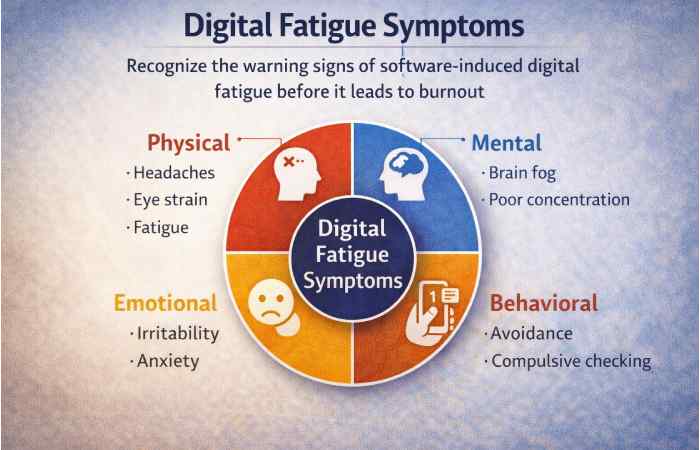
| Category | Specific Symptoms |
| Physical | Persistent tiredness, tension headaches, eye strain, neck/shoulder pain, changes in appetite or sleep patterns |
| Mental | Brain fog, difficulty concentrating, forgetfulness, slowed thinking, reduced creativity |
| Emotional | Irritability, anxiety (especially around tech use), feelings of helplessness, low motivation |
| Behavioral | Avoiding certain tasks, procrastination, compulsive checking of security software, withdrawing from digital collaboration |
Part B: Common Causes Linked to 8tshare6a and Similar Software
| Cause Category | Specific Cause | Why It Applies to 8tshare6a |
| Security anxiety | Fear of malware, data theft, or system damage | 8tshare6a often circulates in pirated bundles; no official developer exists |
| Cognitive overload | Too many apps, constant troubleshooting, fragmented workflows | Unreliable software adds extra mental steps to basic tasks |
| Unpredictable behavior | Crashes, false positives, unexplained slowdowns | Users report hangs at 99% completion, high CPU usage, and iOS app issues |
| Lack of trust | No clear source, support, or version updates | No official website; updates are sporadic or non‑existent |
| Post‑installation regret | Guilt or worry after downloading suspicious software | Many users realize only after installation that the software is not legitimate |
Part C: Treatment Approaches
1. Immediate actions (next 24 hours)
- Uninstall the software. Go to your system settings and remove 8tshare6a completely.
- Run a full malware scan. Use reputable antivirus software (e.g., Windows Defender, Malwarebytes) to detect and remove any hidden threats.
- Restart your computer. This clears temporary processes and refreshes system resources.
- Change critical passwords. If you suspect any data exposure, update passwords for email, banking, and work accounts.
2. Short‑term recovery (next 1–4 weeks)
- Adopt a digital hygiene routine. Schedule weekly system scans, update all software from official sources, and review installed programs monthly.
- Limit app overload. Use the “one tool per task” principle: for file sharing, choose one verified platform and stick to it.
- Implement work‑hour boundaries. Define specific times for email, messaging, and file management to reduce context‑switching.
- Practice micro‑breaks. Every 60 minutes, step away from the screen for 2–3 minutes to reduce eye strain and mental fatigue.
3. Long‑term resilience (1–3 months)
- Build a trusted software list. Identify and stick to well‑known, audited applications for your core tasks.
- Develop a security response plan. Know exactly what steps to take if you suspect malware – this reduces panic and decision fatigue.
- Prioritize sleep hygiene. Keep screens out of the bedroom and establish a consistent bedtime routine to support recovery from digital stress.
- Consider professional support. If fatigue or anxiety persists, consult a healthcare provider. Digital burnout is a recognized condition, and therapy or stress management programs can help.
Step‑by‑Step 30‑Day Digital Wellness Plan for US Adults
| Week | Focus | Daily Actions |
| Week 1 | Audit and cleanse | Uninstall suspicious software; run full malware scan; change passwords for critical accounts; track energy levels in a journal |
| Week 2 | Boundary setting | Define work hours (e.g., 9 AM – 5 PM) and stick to them; implement a digital sunset 60 min before bed; batch file tasks into one dedicated hour |
| Week 3 | Tool consolidation | Choose one verified tool per task category (file sharing, project management, communication); delete redundant apps; schedule weekly system maintenance |
| Week 4 | Resilience building | Practice a daily 10‑minute mindfulness or breathing exercise; establish a “no‑tech” hobby (reading, walking, cooking); review progress and adjust as needed |
By the end of 30 days, most adults report improved morning energy, reduced anxiety around digital tasks, fewer tension headaches, and a greater sense of control over their digital environment.
Comparison Table: 8tshare6a vs. Verified File‑Sharing Alternatives
| Apsect | 8tshare6a (Suspicious) | Verified Alternative (e.g., WeTransfer, Dropbox) |
| Developer identity | None – no official website or brand | Clear, publicly traded or well‑known companies |
| Security | Often bundled with malware, spyware, or PUPs | Regular security audits, encryption standards, GDPR/SOC2 compliance |
| Customer support | None – no help desk or documentation | Email, chat, phone, and extensive knowledge bases |
| Update frequency | Sporadic or non‑existent | Regular updates with patch notes and security fixes |
| Mental load | High – triggers anxiety, troubleshooting, and hypervigilance | Low – predictable, reliable, and easy to use |
| Recommendation | Avoid | Use |
FAQs
Q1: What is the new software name 8tshare6a USA?
It is a file management and media conversion tool that has gained attention for fast transfers. However, it lacks an official developer and is often distributed via pirated software bundles, posing security and health risks.
Q2: Can 8tshare6a cause fatigue or burnout?
Yes. Unreliable software triggers cognitive overload, security anxiety, and unpredictable behavior – all of which contribute to digital fatigue, stress, and burnout in US adults.
Q3: Is 8tshare6a safe to download?
No. Independent investigations warn that 8tshare6a often contains malware, spyware, or cracked software. Downloading it from third‑party sites is strongly discouraged.
Q4: I already have 8tshare6a installed. What should I do?
Uninstall it immediately, run a full system malware scan, change your passwords, and monitor your accounts for suspicious activity. Then follow the 30‑day digital wellness plan outlined above.
Q5: How can I tell if software is legitimate before downloading?
Look for an official developer website with clear contact information, user reviews from trusted sources, and security certifications. If none exist, treat the software as suspicious.
Q6: What are the symptoms of digital fatigue?
Symptoms include persistent tiredness, brain fog, irritability, anxiety, tension headaches, eye strain, and difficulty concentrating. These often worsen after prolonged computer use.
Q7: Can digital fatigue affect my physical health?
Yes. Chronic digital fatigue is linked to disrupted sleep, weakened immunity, musculoskeletal pain, and even gastrointestinal issues. It is a real physiological condition, not “all in your head”.
Q8: Are there safe alternatives to 8tshare6a?
Yes. Verified file‑sharing tools include WeTransfer, Dropbox, Google Drive, and OneDrive. These have clear developers, regular security updates, and customer support.
Q9: When should I see a doctor about fatigue?
If fatigue persists for more than two weeks despite lifestyle changes, or if it is accompanied by chest pain, severe headache, vision changes, or thoughts of self‑harm, seek medical attention immediately.
Q10: How can I reduce digital fatigue in my daily life?
Implement a digital sunset (no screens 60 min before bed), use one trusted tool per task, schedule regular breaks, and perform weekly system audits to remove unused or suspicious software.
Conclusion
The new software name 8tshare6a USA may promise fast file transfers and AI‑powered convenience, but its hidden identity – no official developer, frequent bundling with pirated software, and serious security risks – makes it a dangerous choice for US adults. Beyond the immediate threat of malware, using such unreliable software can trigger a cascade of negative health effects: chronic stress, cognitive overload, sleep disruption, and persistent fatigue.
You do not have to live with digital exhaustion. By recognizing the symptoms, removing problematic software, and adopting a structured digital wellness plan, you can reclaim your energy, protect your mental health, and build a safer, more sustainable digital environment. Start today – your mind and body will thank you.
