
The US creator economy is booming like never before. According to the IAB’s 2025 Creator Economy Ad Spend & Strategy Report, US creator ad spend reached an astonishing $37 billion in 2025—growing nearly four times faster than the overall media industry. Forecasts for 2026 are even more staggering, with projections climbing to $43.9 billion. The global creator economy is now valued at over $250 billion.
But behind the headlines of record growth, a quieter and more alarming story is unfolding. The very engine driving this economic boom is running dangerously low on fuel. Recent creator economy news today from the USA reveals a workforce in crisis: a landmark study by Creators 4 Mental Health, conducted in partnership with the Harvard T.H. Chan School of Public Health, found that 62% of creators report experiencing burnout, 52% struggle with anxiety, and 35% have suffered from depression.
This guide goes beyond the surface-level news to provide a comprehensive analysis of the creator burnout crisis, helping you recognize the symptoms, understand the root causes, and take actionable steps to recover.
Table of Contents
Quick Summary Table: The Creator Health Crisis at a Glance
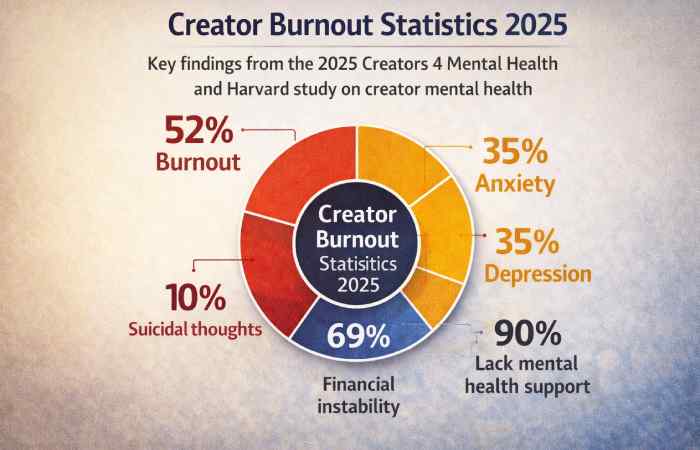
| Metric | Statistic | Source |
| Burnout rate | 52% of creators report burnout | C4MH/Harvard Study (2025) |
| Anxiety rate | 35% experience anxiety | C4MH/Harvard Study (2025) |
| Depression rate | 35% have suffered from depression | C4MH/Harvard Study (2025) |
| Suicidal thoughts | 10% report work-related suicidal thoughts—nearly double the US average | C4MH/Harvard Study (2025) |
| Financial instability | 69% struggle with financial instability | C4MH/Harvard Study (2025) |
| Lack of mental health support | 9 in 10 lack access to specialized mental health resources | C4MH/Harvard Study (2025) |
| US creator ad spend (2025) | $37 billion | IAB Report (2025) |
| Projected US creator ad spend (2026) | $43.9 billion | IAB Report (2025) |
| Active creators globally | 127 million | NeoReach (2025) |
What Most People Misunderstand About Creator Burnout
“Creators have it easy—they just make videos.”
This is the most dangerous misconception. Creator work is not a hobby; it is a high‑pressure, 24/7 job that requires wearing multiple hats: content creator, editor, marketer, accountant, community manager, and business strategist. Unlike traditional workers, creators rarely have clear boundaries between work and life, and they lack basic protections like health insurance, paid leave, or retirement plans.
“Burnout is just being tired. You can sleep it off.”
Burnout is not ordinary tiredness. It is a state of emotional, physical, and mental exhaustion caused by prolonged stress. Sleep alone does not fix it. Creator burnout often manifests as a loss of creativity, cynicism toward work, and reduced professional efficacy—symptoms that persist even after rest.
“More followers and more money will fix the stress.”
Data suggests otherwise. Creators who have worked for five years or more report the highest rates of burnout, stress over content performance, and financial instability. The pressure to maintain relevance, meet algorithm demands, and constantly outperform previous content only intensifies over time.
When to Worry / When Not to Worry
| Symptom | When NOT to Worry | When to Worry |
| Feeling tired after a long week | Resolves after a weekend of rest | Persistent exhaustion lasting >2 weeks |
| Occasional creative block | Lasts a few hours or a day | Inability to create for weeks; loss of passion for work you once loved |
| Mild anxiety before posting | Temporary and manageable | Anxiety that interferes with daily functioning or sleep |
| Checking analytics a few times a day | Within normal work habits | Obsessively checking analytics “before brushing teeth” every morning |
| Feeling behind on content | Manageable with planning | Complete inability to produce content despite financial pressure |
Seek professional help immediately if you experience persistent suicidal thoughts, severe depression, panic attacks, or an inability to perform basic daily activities. The study found that 10% of creators report suicidal thoughts related to their work—nearly double the rate of the broader US population.
Common Mistakes Creators Make That Worsen Burnout
| Mistake | Why It Worsens Burnout | What to Do Instead |
| Checking analytics obsessively | 65% of creators obsess over content performance; 58% say their self-worth drops when content underperforms | Limit analytics checks to once daily at a scheduled time |
| Skipping breaks to maintain the algorithm | Creates physical exhaustion and diminishing creative returns | Schedule regular, guilt‑free breaks; the algorithm will still be there |
| Comparing yourself to viral creators | Fuels feelings of inadequacy and anxiety | Focus on your own growth metrics and personal benchmarks |
| Working in isolation | 43% of creators report feeling isolated because of their work | Join creator communities, co‑working spaces, or accountability groups |
| Ignoring physical health | Poor sleep, nutrition, and exercise directly impair mental resilience | Treat physical health as foundational to creative work |
| Tying self‑worth to engagement | Creates emotional instability and dependence on external validation | Separate your identity as a person from your content’s performance |
Real-Life Interpretation Examples
Example 1: The Full‑Time TikToker in Los Angeles
Situation: Jessica, 28, quit her marketing job to become a full‑time lifestyle creator. She now has 500,000 followers and earns $8,000–$12,000 per month, but she works 70‑hour weeks, feels constant pressure to stay relevant, and has stopped seeing friends. She recently posted a video that underperformed, and her views dropped 80% overnight. She spent the next three days unable to get out of bed.
Interpretation: Jessica is experiencing classic burnout syndrome. Her self‑worth is tied to metrics she cannot control, she has lost work‑life boundaries, and she lacks a support system. The financial pressure to maintain her income level makes taking a break feel impossible.
Solution: Jessica needs to diversify her income streams to reduce platform dependency, implement strict work‑hour boundaries, and seek therapy (services like CreatorCare offer sliding‑scale rates starting at $60).
Example 2: The Side‑Hustle Creator in Austin, Texas
Situation: Marcus, 34, works a full‑time IT job and runs a YouTube channel about vintage gaming as a side hustle. He earns $500–$1,000 per month from ad revenue and sponsorships. He loves the creative outlet but finds himself staying up until 2 AM editing videos, then struggling through his 9‑to‑5 job the next day. His wife has noticed he is increasingly irritable and withdrawn.
Interpretation: Marcus is experiencing burnout driven by overextension, not by the scale of his success. He is sacrificing sleep and relationships for a side hustle that has not yet replaced his primary income. Research shows that nearly half of US professionals (44%) are earning income from side hustles, with 48% of Gen Z, 40% of Millennials, and 45% of Gen X and Baby Boomers currently making passive income from them.
Solution: Marcus needs to reassess his time allocation, set a sustainable publishing schedule (e.g., one video per week instead of three), and prioritize sleep. He should also consider whether the side hustle brings him joy or merely adds stress.
Example 3: The Micro‑Creator in Chicago
Situation: Elena, 22, is a college student and micro‑influencer with 15,000 followers on Instagram. She creates content about sustainable fashion. She does not earn enough to live on, but she feels constant pressure to grow her audience and secure brand deals. She checks her analytics before brushing her teeth every morning and feels “like a failure” when engagement drops.
Interpretation: Elena represents the majority of creators—nano and micro‑influencers make up over 67% of all creators globally. She is experiencing the “performance trap”: the longer she stays in the industry, the worse her mental health becomes.
Solution: Elena needs to decouple her self‑worth from engagement metrics, set realistic growth goals, and build a support network of fellow creators who understand the unique pressures of the industry.
Who This Article Is For / Not For
This article is for:
- Full‑time content creators (YouTubers, TikTokers, Instagrammers, podcasters, bloggers)
- Part‑time or side‑hustle creators experiencing fatigue or burnout symptoms
- Brand managers, agencies, and marketers who work with creators
- Family members or friends concerned about a creator’s well‑being
- Anyone following creator economy news today in the USA and wondering about the human cost behind the growth
This article is NOT for:
- People seeking traditional medical advice for fatigue unrelated to digital work
- Individuals looking for platform‑specific growth hacks or monetization strategies
- Those experiencing severe medical symptoms without first consulting a healthcare provider
Doctor-Level Explanation: The Physiology of Creator Burnout
Creator burnout is not “all in your head.” It has measurable physiological effects.
Chronic stress response: The constant pressure to create, engage, and perform keeps the body’s sympathetic nervous system (fight‑or‑flight) chronically activated. This leads to elevated cortisol levels, which over time impair immune function, disrupt sleep, and contribute to anxiety and depression.
Dopamine dysregulation: Social media platforms are designed to deliver intermittent rewards (likes, comments, shares) that trigger dopamine release. Over time, the brain becomes desensitized, requiring more engagement to achieve the same feeling—a phenomenon researchers call the “dopamine trap.” One creator described it as: “There’s no warning. One day your views drop by 80%, and you’re left wondering what you did wrong”.
Sleep disruption: Late‑night editing, responding to comments, and scrolling feeds before bed suppress melatonin production and disrupt circadian rhythms. Chronic sleep deprivation impairs cognitive function, emotional regulation, and creative thinking—the very tools creators rely on.
Social isolation paradox: Despite being constantly connected online, 43% of creators report feeling isolated because of their work. Parasocial relationships with audiences do not replace real human connection, and the “always‑on” nature of creator work leaves little time for in‑person relationships.
Symptoms + Causes + Treatment: A Structured Guide
Part A: Symptoms of Creator Burnout
Physical symptoms:
- Persistent exhaustion not relieved by sleep
- Frequent headaches or muscle tension
- Changes in appetite or sleep patterns
- Lowered immunity (getting sick more often)
Mental symptoms:
- Loss of creativity or “creative block” lasting weeks
- Difficulty concentrating or making decisions
- Cynicism toward content creation or your audience
- Feeling detached from your work or purpose
Emotional symptoms:
- Irritability or mood swings
- Anxiety specifically related to posting or checking metrics
- Feelings of inadequacy or imposter syndrome
- Reduced satisfaction from achievements
Behavioral symptoms:
- Procrastination or avoiding content creation
- Withdrawing from friends and family
- Checking analytics compulsively (multiple times per hour)
- Neglecting basic self‑care (eating, sleeping, exercising)
Part B: Common Causes of Creator Burnout
| Cause Category | Specific Cause | Why It Affects Creators |
| Algorithm pressure | Constant changes to platform algorithms | Content that performed well yesterday may flop today, creating unpredictability |
| Financial instability | 69% struggle with financial instability | Irregular income makes it impossible to plan or take breaks |
| Always‑on culture | No clear work‑life boundaries | “I’m on vacation and still editing captions in the hotel room” |
| Metric obsession | 65% obsess over content performance | Self‑worth becomes tied to likes, views, and engagement |
| Isolation | 43% report feeling isolated | Lack of peer support and understanding from non‑creator friends/family |
| Lack of support systems | 9 in 10 lack access to specialized mental health resources | Traditional workplace mental health benefits do not apply to creators |
| Platform dependency | Single‑platform reliance creates vulnerability | A platform change, ban, or algorithm shift can destroy income overnight |
Part C: Treatment Approaches (Evidence-Based)
1. Immediate actions (next 24 hours)
- Step away from analytics. Do not check engagement metrics for 24 hours.
- Take a complete day off. No content creation, no social media scrolling, no emails.
- Sleep. Prioritize 8 hours of uninterrupted sleep.
- Reach out. Text or call one trusted friend or family member.
2. Short‑term interventions (next 1–4 weeks)
- Implement work‑hour boundaries. Set a specific start and end time for creator work each day.
- Schedule a digital sunset. No screens for 60 minutes before bed.
- Batch content creation. Create multiple pieces of content in one session to reduce daily pressure.
- Seek professional help. Services like CreatorCare offer sliding‑scale therapy ($60–$180 per session) with licensed therapists who specialize in creator‑specific stressors. Created in partnership with Revive Health Therapy and Creators 4 Mental Health, CreatorCare connects digital workers to mental health professionals familiar with dopamine addiction, financial instability, and algorithm anxiety.
- Join a creator community. Organizations like Creators 4 Mental Health offer peer support and resources.
3. Long‑term resilience building (1–3 months)
- Diversify income streams. Reduce platform dependency by adding multiple revenue sources (merchandise, digital products, consulting, affiliate marketing).
- Build a support network. Cultivate relationships with fellow creators who understand the unique pressures of the industry.
- Develop a self‑worth framework separate from metrics. Identify personal values and sources of meaning outside of content performance.
- Create an emergency plan. Have savings and a contingency plan in case of platform changes or burnout requiring extended time off.
Step-by-Step 30-Day Creator Recovery Plan
| Week | Focus | Daily Actions |
| Week 1 | Detox and assessment | No analytics checking for 7 days; track sleep, mood, and energy levels in a journal; identify your biggest stress triggers |
| Week 2 | Boundary setting | Define work hours (e.g., 10 AM – 4 PM) and stick to them; implement a digital sunset 60 min before bed; batch content creation to 2 days/week |
| Week 3 | Support activation | Reach out to one creator peer daily; schedule a therapy session (CreatorCare, BetterHelp, or local provider); join an online creator support group |
| Week 4 | Systems building | Diversify one income stream; create a sustainable publishing schedule (e.g., 3 posts/week instead of daily); develop a post‑break plan for returning to work |
By the end of 30 days, most creators report improved sleep quality, reduced anxiety around posting, renewed creative energy, and a healthier relationship with metrics.
Comparison Table: Creator Burnout vs. Traditional Workplace Burnout
| Aspect | Creator Burnout | Traditional Workplace Burnout |
| Primary driver | Algorithm pressure, metric obsession, financial instability | Heavy workload, lack of control, insufficient reward |
| Work boundaries | Virtually none—work bleeds into all hours | Defined work hours (usually) |
| Support systems | 9 in 10 lack specialized mental health access | Often have EAP, HR, health insurance |
| Financial stability | 69% struggle with financial instability | Regular paycheck, benefits, paid leave |
| Performance feedback | Public, immediate, and often harsh (comments, likes) | Private, periodic performance reviews |
| Recovery approach | Requires platform detox, income diversification, boundary setting | Requires workload reduction, PTO, management support |
FAQs
Q1: What is the latest creator economy news today in the USA?
The US creator economy is projected to reach $43.9 billion in ad spend in 2026, but a mental health crisis is emerging: 62% of creators report burnout, 52% have anxiety, and 1 in 10 have suicidal thoughts related to their work.
Q2: What percentage of creators experience burnout?
According to a 2025 study by Creators 4 Mental Health and Harvard T.H. Chan School of Public Health, 62% of creators report experiencing burnout.
Q3: Why do creators experience so much anxiety and depression?
Key factors include financial instability (69% struggle), metric obsession (65% obsess over performance), isolation (43% feel alone), lack of work‑life boundaries, and the absence of traditional workplace support systems.
Q4: Where can creators get mental health support?
CreatorCare offers sliding‑scale therapy ($60–$180 per session) specifically for digital creators, with licensed therapists who understand creator‑specific stressors. Other options include BetterHelp, Talkspace, and local therapists specializing in burnout.
Q5: Is creator burnout different from regular burnout?
Yes. Creator burnout is uniquely driven by algorithm unpredictability, public performance metrics, financial instability, and parasocial relationships with audiences—stressors not typically present in traditional workplaces.
Q6: How can I tell if I’m burned out or just tired?
Burnout persists despite rest and often includes cynicism toward work, reduced professional efficacy, and emotional exhaustion. If taking a weekend off does not restore your energy, you may be experiencing burnout.
Q7: Can side‑hustle creators experience burnout too?
Yes. Nearly half of US professionals (44%) earn income from side hustles, and many experience burnout from overextension, sleep deprivation, and the pressure to maintain both a full‑time job and a creator career.
Q8: What should I do if I’m having suicidal thoughts as a creator?
Seek immediate help. Call or text 988 (the Suicide and Crisis Lifeline) for confidential support. You are not alone—10% of creators report work‑related suicidal thoughts.
Conclusion
The creator economy news today in the USA tells two parallel stories. On one hand, record growth: $37 billion in ad spend in 2025, projections of $43.9 billion in 2026, and over 127 million active creators globally. On the other hand, a workforce in crisis: 62% burnout, 52% anxiety, 35% depression, and 1 in 10 suicidal thoughts.
These numbers are not abstract statistics. They represent real people—full‑time creators, side‑hustlers, micro‑influencers—who are exhausted, anxious, and often alone. The good news is that burnout is treatable, recovery is possible, and support is becoming available. Platforms like CreatorCare are stepping up to fill the gap. Creator communities are forming. Awareness is growing.
If you are a creator reading this and recognizing your own symptoms, know this: you are not weak, you are not failing, and you are not alone. The system you are working in was not designed with your well‑being in mind. But you can design your own boundaries, your own support systems, and your own path to recovery. Start with one small change today. Your creativity—and your health—will thank you.
